
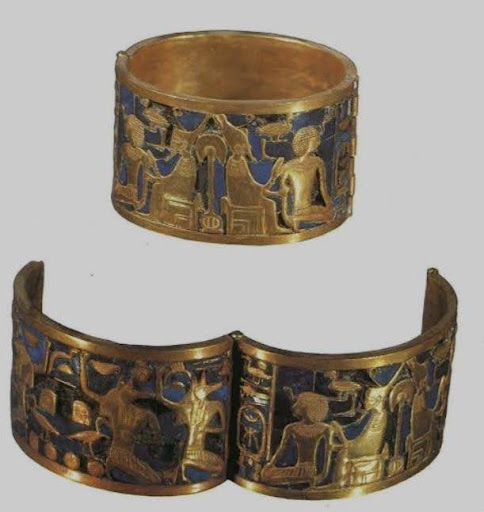
The bracelet of “Queen Ahhotep I '" was an ancient Egyptian queen who lived c. 1560–1530 BCE, during the end of the Seventeenth Dynasty and beginning of the Eighteenth Dynasty of Egypt.
This golden bracelet of Queen Ahhotep I was found among the mummy’s hair. It was thought to be a crown. But because of its diameter, it was almost certainly worn around the arm for protection.
This bracelet of Queen Ahhotep I is formed with two semicircles. Gold and lapis-lazuli were used to create its beautiful two-color decoration. The right semicircle depicts Geb, the god of earth, wearing the double crown and seated on the throne. His hands rest on a sign of protection that is on the shoulder and arm of the king kneeling before him.
The other half of the bracelet is engraved with a falcon and a jackal-headed figure representing the Souls of Pe and Nekhen, the mythical ancestors of the rulers of Egypt before unification. Kneeling, their arms are raised in the henu position, typically used in ceremonies and celebrations.
The Souls of Pe and Nekhen of are depicted in the kneeling kneeling pose and the placement of the arms are part of temple rituals by which gods and kings as living gods were hailed by this gesture of jubilation.
The gesture of jubilation was called ‘henu’. The pose is also indicative of their readiness to hammer the enemies of their lawful descendants.
The souls of the figures were referred to as the ‘Bau’. In ancient Egyptian mythology, the concept of the soul was complex and multifaceted.
The Egyptians believed in multiple components of the soul, including the ka, ba, akh, and others. The deities are upholders of the divine right of kingship inherited by the ruler in his manifestation as the god Horus.
Most of the objects found in the tomb of Queen Ahhotep bear the names of her sons, Kamose and Ahmose, the kings that chased the Hyksos out of the country.
The queen played a major role during the war of liberation as testified by the many objects that her sons donated to her grave goods. Some of those gifts were weapons, unusual for a woman’s tomb.